

 Email
Email Request a Callback
 Frequently Asked Questions

Sign up for the Newsletter
Gmelina arborea is a
fast-growing tropical hardwood.
Like all tropical hardwoods it grows year-round, but the Melina life cycle is shorter than competing timbers, reaching an optimal harvesting height of 30m in 12 years, compared with teak which takes 20-25 years. Melina tolerates shallow soils and steep terrains, and has a high resistance to pests, making it a logical choice for plantation harvesting in Costa Rica.
Melina is in high demand as a versatile construction material: it’s light and strong, smooth and lustrous, easy to work with and stains well, and doesn’t warp or split when properly seasoned.
“This straw-colored wood is one of the best utility timbers of the tropics, where it is used in light construction, general carpentry, packaging, furniture, particle board, plywood, and matches. The wood produces average yields of paper with properties superior to those from most hardwood pulps.”
Association of South-East Asian Nations (ASEAN)
Forest Tree Seed Center, Thailand
Appearance
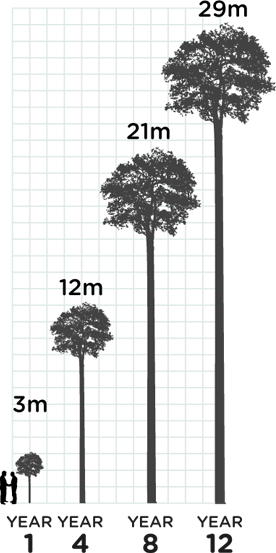
Gmelina arborea is an unarmed, moderately sized to large deciduous tree with a straight trunk. It is wide spreading with numerous branches forming a large shady crown, attains a height of 30 m or more and a diameter of up to 4.5 m. Bark is smooth, pale ashy-grey or grey to yellow with black patches and conspicuous corky circular lenticels.
Gmelina arborea wood is pale yellow to cream coloured or plukish-buff when fresh, turning yellowish brown on exposure and is soft to moderately hard, light to moderately heavy, lustrous when fresh, usually straight to irregular or rarely wavy grained and medium course textured.
Working Properties
Melina is regarded as a valuable general-purpose wood because of its dimensional stability. Density: 400-560 kg/cubic m
Melina responds readily to hand tools to yield smooth, clean surfaces. The dulling effect on cutting edges is slight. Melina is easy to saw, bore, mortise, carve, glue, nail, sand, polish, and takes stain, varnish and paint well.

Native: Bangladesh, Cambodia, China, India, Japan, Laos, Myanmar, Nepal, Pakistan, Sri Lanka, Thailand, Vietnam
Exotic: Brazil, Costa Rica, Cote d'Ivoire, Ethiopia, Gambia, Ghana, Honduras Kenya, Malawi, Malaysia, Nigeria, Panama, Phillipines, Sierra Leone, Sudan, Tanzania, Uganda, Zambia
Geographic Distribution
Melina is a species with broad natural distribution in southeast Asia, and grows from sea level to 1,000 m above sea level. It has been introduced in tropical countries and has been very successful under a wide range of climatic conditions. In Latin America, the species has been planted mainly in Costa Rica, Brazil, Venezuela and Guatemala. The species grows in the following life zones:
- Very Humid Tropical Forest, Humid Tropical Forest, and Dry Tropical Forest in sites where the average annual precipitation is between 1,000 and 3,000 mm
- From sea level to 500 m of elevation and with average temperatures between 24 and 35 °C (Murillo and Valerio 1991).
In Costa Rica, Melina has been observed growing well up to 600 m above sea level with average annual precipitation of up to 2,500 mm and 2 - 4 dry months per year.

Uses
Melina is used in the manufacture of a wide range of wood products.
- Structural framing in houses and industrial settings (such as mines).
- Shipbuilding: framing, decking and oars.
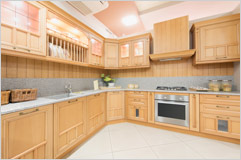
- Doors and window frames, joinery, flooring, molding, posts and beams, cabinets, cupboards and finish carpentry work.
- Utility and high-end furniture: bedroom suites, chairs, desks, drawers, tables, chests, stools, wardrobes, shelving, picture frames, drawing boards, blackboards.
- Plywood, particleboard, matches, stakes, boxes, crates and pallets.
- Musical instruments, tool handles, tennis rackets and artificial limbs.
Wood from the butt of the tree is used for plywood, veneers and high end furniture; the middle range is used for dimensional lumber for the construction industry; the upper reaches are used for making pallets and other packing materials. Melina also produces good quality pulp used in the manufacture of cardboard and various grades of paper.
Melina in Costa Rica
Today Melina represents approximately 20% of the lumber milled in Costa Rica, but it’s not a native species. In the 1990s, when forest preservation initiatives resulted in the prohibition of harvesting of many native species, agriculturalists began to look abroad for suitable reforestation species, and discovered Melina.
After submitting Melina to genetic improvement, a Costa Rican provenance was developed that yields 22% more volume than the initial imported strains, with enhanced disease resistance. Timberland Futures uses this improved strain exclusively, certified by the National Seed Office of Costa Rica.
Timberland Futures has located its plantations near Siquirres - the site of the first Melina plantation - on the gentle slopes of the Atlantic coast where high annual rainfall, good drainage characteristics and rich volcanic soil make for optimal growing conditions for Melina. Nearby, there is high demand for Melina pallets in the port of Limon, the export center for Costa Rican bananas, pineapple and all products destined for Europe and the eastern seaboard of the Americas.
Etymology
Melina means honey in greek and the tree’s flowers produce abundant nectar, which produces high-quality honey, but that’s not where the name comes from. The genus Gmelina was named by Carl Linnaeus in honour of Johann Georg Gmelin (1709-1755) Professor of Medicine, Botany and Chemistry in Tübingen, Germany, and an explorer in Siberia in the service of the Tsar of Russia.
Individual investors can now benefit from this emerging investment opportunity.
Contact a Timberland Futures account representative or download our free prospectus.
 PROFILE: MELINA
Melina (gmelina arborea) is a fast-growing hardwood that provides quick returns, and a popular construction material for housing and furniture that sells quickly on international markets.
 PROFILE: COSTA RICA
With a stable democratic government, progressive international trade agreements and lush tropical climate, Costa Rica is the ideal location to invest in forestry.
 INVESTMENT STRUCTURE
Timberland Futures grows your trees, harvests them, and sells them at current market value, giving you periodic returns on your investment. Get the specifics of the basic investment structure.