

 Email
Email Request a Callback
 Frequently Asked Questions

Sign up for the Newsletter
Why do timber investments perform so well?
Trees have a long harvesting window
Unlike other agricultural commodities, trees have an extremely long life-cycle. If market conditions at planned harvest time are unfavorable, wood can be “banked on the stump” practically indefinitely until prices rise, the whole time growing steadily in real value – or be cut early to seize a financial opportunity. The same can’t be said for coffee or grains.
The demand for timber is increasing
As the world population grows, so does the demand for timber. Currently the U.S. is the world’s #1 consumer of wood at 27% of the world’s supply, but the balance is shifting towards Asia as the economies of the developing countries like China, India and South Korea hit their strides.
“The equivalent of almost 50 cities the size of greater London will have to be built over the next 20 years to house China’s growing urban population alone.”
Editor, The Global Guru.
“The most recent projections of FAO's Global Forest Products Model estimate that global consumption of industrial round wood in 2030 will be around 2400 million m3, an increase of around 60 percent on current consumption. Much of this increase will result from an increase in population and income in developing countries, leading to an increase in per capita consumption of wood.”
Food and Agriculture Organization
The supply of timber is decreasing
Forests are disappearing. According to the UN Food and Agricultural Organization, half of the forests that originally covered 46% of the Earth’s land surface, half are gone, only one-fifth are undisturbed, and 2% more disappear every year, as developing countries like China, India and South Korea hit their strides.
With growing demand and shrinking supply,
expect strong timber prices.
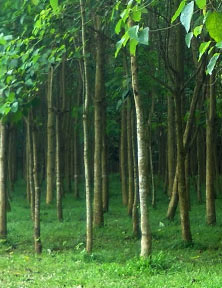
Melina hardwood prices on the rise
Prices for Timber since 1987-2005 have averaged 14.81% and Melina hardwood pricing since 2005 has been increasing at an average of 12.33% per year.
| % Increase in Price by Year, Melina Timber, Sawn | |||||||
|---|---|---|---|---|---|---|---|
| 2006 | 2007 | 2008 | 2009 | 2010 | 2011 | 2012 | 2013 |
| +17.3% | +18.3% | +31.6% | +5.0% | -0.5% | +19.0% | -9.6% | +1.0% |
In the wake of the 2009 financial crisis and new housing market bust, prices for Costa Rican Melina hardwood actually increased.
Jump to: What’s special about Melina?
Timber is a smart hedge against market volatility
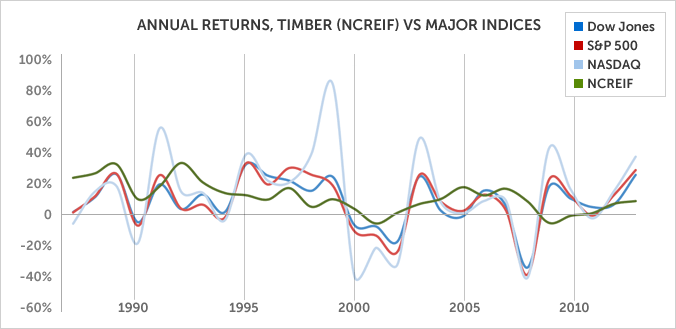
With a low correlation (< +0.1) to other asset classes, timber is an effective way to diversify your portfolio and distribute risk.
The many differing uses of wood insulates investors from market downturns. During a housing slump, timber can be sold to other wood-product manufacturers or paper companies. Melina is particularly versatile in this respect: being strong, light and resistant, Melina is prized in the manufacture of furniture, joinery, musical instruments, artificial limbs, tool, instruments and sporting equipment.
“During the Great Depression, when stocks plunged more than 70%, timber gained 233%. And timber easily outperformed the S&P 500 during the 20th century's other major bear-market periods. Most recently, in 2008, when the S&P 500 lost 38%, the NCREIF Timberland Index gained 9.5%.”
Money Morning
Timber is a smart hedge against inflation
“If you look at commodities, you find a pattern that all of them share, except timber, had a declining real price up until 10 years ago. But standing timber has a long-term record of modestly rising prices.”
Grantham Mayo van Otterloo
“In the modern era, inflation has never been a match for timber, which has risen faster than overall prices for more than a century. During America's last major inflationary period - from 1973 to 1981, when inflation averaged 9.2% - timberland values increased by an average of 22% per year. On average, the price of harvested lumber itself has risen more than 5% annually over the past 100 years.”
Money Morning

Reforestation reduces greenhouse gasses by sequestering carbon
An investment in forestry is an investment in a brighter, cleaner future for everyone. As a newly-planted forest grows, it draws carbon from the atmosphere, ameliorating the damage resulting from harmful practices - past and present - reducing greenhouse gasses and stabilizing global temperatures – all the while earning you an
above-average rate of return.
Excessive carbon dioxide is trapping heat in the earth’s atmosphere. Carbon needs to be taken out of the atmosphere and stored, long-term. Luckily, nature has developed the perfect vehicle for carbon sequestration: trees. Trees lock up carbon in their wood – more than 50% of the dry weight of wood is carbon. For carbon sequestration via reforestation to succeed, the carbon must not be allowed to return to the atmosphere by burning or rotting: manufacturing trees into wood products is a great way to store carbon for the long term. And because younger and faster growing forests sequester more carbon, managed harvesting and reforesting of timberland helps nature do the job.
Timberland Futures can help organizations and individuals offset their carbon footprint by buying carbon credits. To learn how, talk to a Timberland Futures representative.
The need for sustainable forestry has never been greater.
The gap between the rising demand for timber and dwindling supply will be filled with plantation-grown deciduous trees, optimized with modern forestry management practices and botanical science. Due to inherent characteristics, the outlook for timberland investment - with its high, stable returns - has always been good… and the future looks even better.





Individual investors can now benefit from this emerging investment opportunity.
Contact a Timberland Futures account representative or download our free prospectus.
 PROFILE: MELINA
Melina (gmelina arborea) is a fast-growing hardwood that provides quick returns, and a popular construction material for housing and furniture that sells quickly on international markets.
 PROFILE: COSTA RICA
With a stable democratic government, progressive international trade agreements and lush tropical climate, Costa Rica is the ideal location to invest in forestry.
 INVESTMENT STRUCTURE
Timberland Futures grows your trees, harvests them, and sells them at current market value, giving you periodic returns on your investment. Get the specifics of the basic investment structure.